Lindsay

Christensen

  • Home
  • Services
  • Philosophy
  • Blog
  • About
  • Contact

Stepping Out of the Drama Triangle at Work

January 28, 2026 by Lindsay Christensen

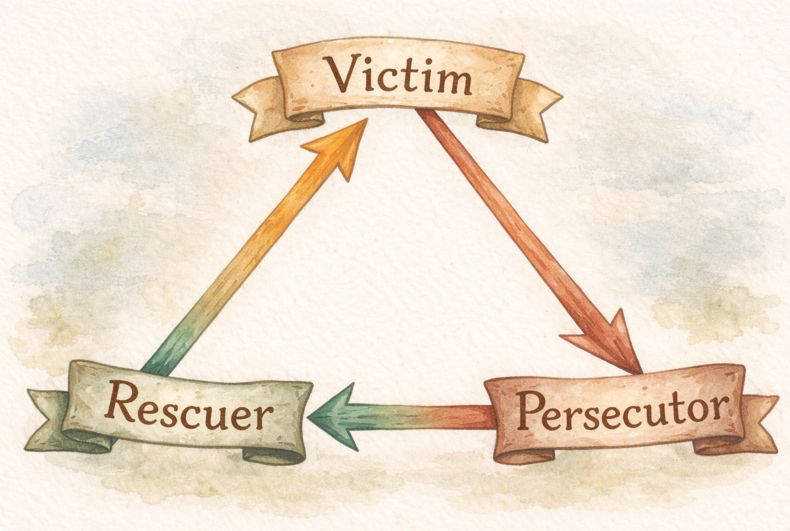
When conflict at work feels stuck, painful, or oddly familiar, it can help to pause and look at the shape of what’s happening rather than only the content. The Karpman Drama Triangle offers one such lens. Not as a way to diagnose or label people, but as a way to notice patterns that quietly keep conflict cycling.

The triangle describes three roles that people can slip into under stress: Victim, Rescuer, and Persecutor. Most of us have occupied all three at different moments, often without realizing it. These roles are less about personality and more about what happens when people feel overwhelmed, unheard, or unsafe.

What makes the triangle so sticky is that each role can feel justified from the inside. The Victim feels harmed or powerless. The Rescuer feels needed and responsible. The Persecutor feels compelled to enforce standards or name what others will not. None of these positions are inherently malicious, and none of them tend to produce relief for very long.

Why the Triangle Feels So Convincing

If you are feeling victimized at work, it is often because something real has happened. A boundary has been crossed. Support has not shown up. Communication has broken down. The triangle does not ask you to deny that reality.

What it does invite is curiosity about what happens next.

When we stay in the Victim role, even understandably, our sense of agency tends to narrow. Options start to feel unavailable. When someone moves into Rescuer mode, they may temporarily relieve discomfort while unintentionally reinforcing dependency or avoiding harder conversations. When someone takes up the Persecutor role, often in the name of accountability or efficiency, fear and defensiveness usually rise.

Over time, these roles can rotate. Today’s Victim becomes tomorrow’s Persecutor. The Rescuer grows resentful and pulls away. The conflict keeps moving, but it rarely moves forward.

Reframing the Triangle Without Blame

One of the most helpful shifts the Drama Triangle offers is this: it separates responsibility from blame.

You can acknowledge harm without freezing yourself inside it. You can recognize power dynamics without surrendering all your choices. You can see how others’ behavior affects you while still asking what is within your influence.

Instead of asking, “Who is wrong here?” the triangle gently redirects us toward a different set of questions:

What role do I seem to be occupying right now?
What role am I inviting others into, even unintentionally?
What would it look like to step sideways instead of deeper in?

This is not about becoming perfectly self-aware or emotionally neutral. It is about creating a little room to breathe where everything had started to feel inevitable.

Moving Toward Agency

Stepping out of the Drama Triangle does not require confrontation, nor does it require silence. It usually begins with a small internal adjustment.

If you notice yourself feeling like a Victim, one place to start is by naming what you actually want or need, rather than only what feels unfair. That might sound like clarifying a boundary, asking a specific question, or deciding where you will stop waiting for permission.

If you tend to slide into Rescuer mode, it can help to pause before fixing. Ask whether your help is being requested or assumed. Consider what would happen if you trusted others to carry some of the discomfort themselves.

If you feel yourself hardening into the Persecutor role, especially under pressure, it can be useful to slow down and ask what fear or urgency might be driving that stance. Often there is a value underneath the intensity that could be expressed more directly.

None of these shifts are about becoming softer or tougher. They are about becoming clearer.

A Different Kind of Power

What the Drama Triangle ultimately points toward is a quieter form of empowerment. One that does not depend on winning, rescuing, or being right. It rests instead on choice, awareness, and self-respect.

You may not be able to change another person’s behavior. You may not be able to fix a broken system on your own. But you can often choose how you participate in the pattern.

Sometimes stepping out of the triangle looks like having a conversation. Sometimes it looks like opting out of one. Sometimes it looks like documenting, redirecting, or deciding that the work you need to do is not internal to this relationship at all.

The point is not to perform emotional mastery. It is to remember that even inside difficult dynamics, you usually have more room to move than it first appears.

Conflict does not stop being hard when we understand it better. But it does become less consuming. And from that steadier place, more honest and effective choices tend to follow.

January 28, 2026 /Lindsay Christensen
workplaceconflict, workplacerepair, conflictresolution, karpmandramatriangle

When You Ask for Support and Don’t Receive It

January 23, 2026 by Lindsay Christensen

When you ask for help at work and feel dismissed or left hanging, it can change everything. This piece explores that experience and how to reclaim some ground.

One of the most destabilizing experiences at work is realizing that the place you turned for support may not be able, or willing, to offer it.

You raise a concern with your manager. You talk with HR. You name a pattern that feels unsustainable or unfair. Maybe you are dealing with a colleague whose behavior feels bullying, dismissive, or persistently disruptive. You are not asking for drama, just for help making the situation workable. And then something deflating happens:

You are told it’s complicated.
You are encouraged to be patient.
You are promised follow-up that never comes.
Or you leave the conversation feeling subtly dismissed, as though the issue is less serious than it feels from where you stand.

The conflict you brought forward does not resolve, but now something else has been added. A sense of being alone with it.

Why This Can Feel So Personal

When leadership response falls short, it can land as a judgment on your experience. People start to wonder whether they are overreacting, misreading the situation, or expecting too much. They replay conversations in their head, searching for the moment they explained it poorly or failed to make their case convincingly enough.

At the same time, anger or resentment can surface. If leadership is aware of the issue and does nothing, it can feel like tacit approval of the behavior. Trust erodes quietly, not just in the individual leader, but in the organization’s willingness to protect its people.

These reactions are understandable. Asking for support is a vulnerable act. When that vulnerability is met with inaction, the disappointment runs deeper than the original conflict.

A Reframe That Can Help Restore Some Ground

It can be useful, though not always comforting, to separate impact from intent when thinking about leadership response.

In many organizations, managers and HR professionals are constrained by competing priorities, unclear authority, legal risk, or organizational politics that are not visible from the outside. This does not excuse inaction, but it can help explain why the response feels vague or incomplete.

In other cases, leaders may genuinely underestimate the impact of the situation, especially if the behavior in question has been normalized over time or if similar concerns have surfaced without consequence before.

None of this means your concern is invalid. It does suggest that what you are encountering may be a limitation of the system rather than a verdict on your credibility or worth.

Clarifying What You Are Actually Asking For

One practical step that can make a difference is getting clearer about the kind of support you are seeking.

Sometimes people go to leadership hoping for accountability or intervention, while leadership hears a request for advice or emotional validation. These mismatches can lead to conversations that feel unsatisfying on both sides.

Before re-engaging, it can help to reflect on what would actually make the situation more workable for you. That might be clearer boundaries, a mediated conversation, explicit expectations for behavior, or a commitment to follow-up within a specific timeframe.

Being able to articulate this does not guarantee action, but it can reduce ambiguity and make it easier to assess whether leadership is able or willing to respond.

When Promises Stall

Few things undermine trust faster than promised action that never materializes.

If you were told that something would be addressed and it was not, it is reasonable to name that. Doing so does not require accusation. A simple check-in that references the earlier conversation and asks about next steps can serve both as a reminder and a test of accountability.

The response you receive will offer important information. Follow-through builds trust. Continued deflection or delay signals limits that you may need to factor into your decisions moving forward.

Reclaiming Agency When Support Is Limited

Perhaps the hardest realization is that leadership may not be able to resolve the situation in the way you hoped. When that becomes clear, the work shifts from waiting for rescue to deciding how you want to care for yourself within the constraints that exist.

This might involve seeking third-party support such as mediation, if available. It might mean adjusting boundaries, documenting interactions more carefully, or limiting exposure where possible. In some cases, it means reconsidering whether the environment can meet your needs over the long term.

None of these choices are easy. But they are choices, and recognizing them can restore a sense of agency that prolonged waiting tends to erode.

A Closing Thought

Feeling unsupported by leadership is not a small thing. It changes how safe it feels to speak, how much energy work requires, and how connected you feel to the organization as a whole.

If you are in this position, it may help to remember that your response is a reasonable reaction to a difficult reality. You are not asking for too much by wanting clarity, follow-through, and protection from harm.

Sometimes the most compassionate move is continuing to advocate, with clearer requests and firmer boundaries. Sometimes it is stepping back and reassessing what is sustainable for you Either way, the absence of support says something about the system you are in. It does not say everything about you. And noticing that distinction can be the first step toward making a choice that honors your dignity, even in imperfect conditions.

January 23, 2026 /Lindsay Christensen

Why Structure Can't Substitute for Relationship (and Vice Versa)

January 15, 2026 by Lindsay Christensen

When organizations lean too hard on structure or relationship alone, conflict often resurfaces. This post explores why both are necessary, and how they work together.

Read More
January 15, 2026 /Lindsay Christensen
workplace relationships, conflict resolution, organizational design, organizational health

Repair at Work: Why It Matters More Than Resolution

January 02, 2026 by Lindsay Christensen

Most workplaces are good at resolution. Fewer are good at repair. This post explores the difference, and why tending relationships matters more than moving on.

Read More
January 02, 2026 /Lindsay Christensen
workplace repair, conflict resolution, workplace culture, organizational trust, trauma-informed leadership

Clarity Is a Form of Care

December 16, 2025 by Lindsay Christensen

When people know where decisions live, what is expected of them, and what is not up for debate, they can relax. Not because everything is easy, but because the ground is stable enough to stand on.

Read More
December 16, 2025 /Lindsay Christensen
leadwithclarity, workplaceconflict, workplacecommunication, workplacewellness, leadershipdevelopment